Showing posts with label reviews. Show all posts
Tuesday, July 17, 2012
Book Review: 11/22/63 by Stephen King
For being such a huge commercial success, I don't think that Stephen King is that great a writer. Of course, that's not uncommon (I'm looking at you, James Patterson). What King excels at is storytelling, not the particular turn of phrase. 11/22/63, though, largely overcomes its occasionally ham-handed prose to tell a heck of a yarn.
Jake Epping is a high school teacher in suburban Maine who stumbles upon a portal into the past, specifically to to a summer afternoon in 1958. Each time he goes back is a complete reset of all previous trips, and, though he takes a couple of side trips along the way, his main mission is to stop Lee Harvey Oswald from assassinating JFK. This obviously involves, if you can subtract, waiting around for more than five years in the past. As I said, though, King is a master storyteller, and he finds plenty for his hero to do.
The book earns demerits for the leaden writing (King mentions that the past is "obdurate" and doesn't want to be changed approximately 1,789 times) and sub-plot recycling (the past also "harmonizes" with itself: 2,342 times), not to mention the crippling problem of never really explaining why Epping feels so compelled to save Kennedy in the first place. It overcomes these obstacles, though, by excelling at prompting the reader to keep turning pages (and it had better; the novel comes in a lean 849 of them!).
King is at his best writing short stories (find The Running Man and burn your VHS copy of the movie) and most of his novels are anything but. 11/22/63 could stand to be 300 pages shorter (which is really saying something!), but is an entertaining read nonetheless.
11/22/63: 3.5 stars out of 5
Friday, May 11, 2012
Movie Review: The Avengers
I was worried about this one for a couple of reasons. First of all, I haven't really been all that into the recent spate of super-hero movies. My favorite of the genre is probably either The Incredibles or The Rocketeer, both very self-aware films, and your average super-hero movie is a little more self-serious. Secondly, I'm no Joss Whedon super-fan. And he's only got super-fans, it seems. You're either a devotee of Buffy, Dollhouse, Firefly, and Serenity or...well, you're just not. And I'm just not (I didn't even love The Cabin in the Woods, though I did like it). I guess it all comes down to whether you like Nathan Fillion or not, right? Third, The Avengers was primed, by its very nature, to be the overstuffed sequel that doesn't live up to the original (think The Matrix Reloaded, Spider-Man 3, and most chillingly for our purposes, Iron Man 2). The film casts six movie stars (though only one mega-star in Robert Downey, Jr., reprising his Iron Man performances) in central roles and has to find something for all of them to do.
Perhaps shockingly, then, The Avengers totally worked for me. While a couple of the quips fall flat, and it stretches believability (I know, I know...) that a spy with two pistols and a gifted archer would be worth having around when The Hulk (Mark Ruffalo), Captain America (Chris Evans), and Thor (Chris Hemsworth) (not to mention the already-mentioned Iron Man) are on your team. Scarlett Johansson's Black Widow squeezes off only three or four rounds in the whole film.
The Avengers is the best of the Marvel adaptations, save the first Iron Man. Far better than the cheesy Thor or Captain America films, it even bests all three Sam Raimi Spider-Man movies, with far better acting being the differentiating factor. It's been a long time since I heard applause at the end of a movie, but The Avengers earned it, at least at the screening I attended. Amazingly, Whedon finds something for all his Avengers to do, gives us a bad guy worthy of six heroes (Tom Hiddleston is great as the scorned yet Shakespearean Loki), and keeps the action pumping. The New York City finale is gloriously over-the-top, and owes a debt of gratitude to Michael Bay's Transformers: Dark of the Moon (yes, you read that right: gratitude).
All in all, good, escapist fun, with a healthy dose of witty banter, exploding buildings, and yes, the salvation of the world.
The Avengers: 3.5 stars out of 5.
Monday, April 16, 2012
Movie Review: Lockout
I think Luc Besson is a genius. His three English language live-action features (The Professional, The Fifth Element, and The Messenger) are three of my favorites. There's no denying that they're, at base, crowd-pleasing schlock, but count me among the pleased crowd. He knows his way around a camera, an impeccably tight screenplay, and action handled deftly and humorously. Perhaps Besson's greatest genius, though, lies in knowing when to hand the reins of a project over to someone else.
Besson's name is the first one on screen in the new film Lockout, which he produced, co-wrote, and for which he had "the original idea." However, his co-writers (and directors) James Mather and Stephen St. Leger (making their feature debut), take all the blame (Note: You know you're in trouble when the film's poster proclaims "From the Producers of Taken." It's like the trailer for Battleship: "From Hasbro, the company that brought you Transformers." Yikes).
Lockout stands in the often-great tradition of films like Die Hard and Under Siege, in which a wise-cracking butt-kicker must go up against a seemingly insurmountable enemy force to save the day. Here, it's Guy Pearce's wise-cracking butt-kicker who must save the President's daughter from a recently-taken-over-by-inmates supermax prison/insane asylum. Oh, and the prison? It's in freaking space. There is so much here for which one must suspend one's disbelief that one might as well check one's disbelief at the door. Seriously, one. Do that. But we American action movie fans are no strangers to the unbelievable. In fact, we relish it. An off-duty cop with no shoes? Check. A trophy-hunting alien with infra-red vision? Check. A combination supermax prison and insane asylum in space? Check. The problem with Lockout lies elsewhere.
Actually, it's in the screenplay and with Maggie Grace, who plays the aforementioned President's daughter. Both are terrible. The cracking wise becomes tiresome quickly, and is incredibly overdone. Grace doesn't know when to be tough or afraid, and her character apparently believes that constantly berating the man who's come into space to save her is a good plan. The screenplay doesn't know when to quit either. The original conceit is plenty, but we get double-crossing secondary characters we didn't care about, sleight-of-hand tricks that don't mean anything, and "witty" banter that's so saccharine it makes our teeth want to rot. It can't even manage to pay off a ham-handed first act foreshadowing.
There are fun moments here, but they simply serve to throw the rest of the picture into tedious relief. All in all, I wish Besson had directed this generic actioner; perhaps he could have brought something unique to the table. Oh, well...next time I'll just watch The Fifth Element instead.
Lockout: 1.5 stars out of 5.
Monday, March 26, 2012
Movie Review: Jeff, Who Lives at Home
Jay and Mark Duplass, perhaps best known for the recent comedy Cyrus, are known for their contributions to the sub-genre known as "mumblecore." A cinematic movement characterized by ultra-low production values, tiny-in-scope stories, and amateur actors, most mumblecore films struggle to be accessible to wide audiences. Cyrus may be, in fact, the only mumblecore film you've ever heard of, and that's because it starred "real" actors (John C. Reilly, Marisa Tomei, and Jonah Hill). The Duplass brothers have gone the real actors route again in Jeff, Who Lives at Home, casting Jason Segel and Ed Helms as brothers and Susan Sarandon as their mother. Whether they give these actors anything in particular to do, though, is another matter.
In fact, "having something to do" is a major theme of Jeff. Segel plays the titular Jeff, who does indeed live at home. He's a man who waits for signs from the Universe, and tries to follow them. It's led him, perhaps predictably, to do next to nothing. He's estranged from his brother, but a series of coincidences (or are they?) repeatedly bring them together, while the boys' mother deals with a secret admirer at work. The film is really about how three different people deal with a major life question: what should I do, and why? The performances are all good, and the writing is excellent. A hallmark of a Duplass brothers script (and most mumblecore writing) is that the people talk like real people talk. It's quite enjoyable to watch these characters talk about life's questions.
Jeff, Who Lives at Home, though, is short on answers...on purpose. The "action," if it can be called that, shambles along, one thing happens and then another, until a huge unexpected crisis arises out of nowhere. Is the universe telling you what to do by inscrutable signs? Are you on your own to figure out your purpose? Jeff, Who Lives at Home isn't telling, but it's a pleasant experience nonetheless. Watching Jeff is like a visit back to the house you grew up in: it's a little ramshackle now, everything seems smaller than you remember it, but it's comfortable, and you wouldn't want to be anywhere else.
Jeff, Who Lives at Home: 3.5 stars out of 5
In fact, "having something to do" is a major theme of Jeff. Segel plays the titular Jeff, who does indeed live at home. He's a man who waits for signs from the Universe, and tries to follow them. It's led him, perhaps predictably, to do next to nothing. He's estranged from his brother, but a series of coincidences (or are they?) repeatedly bring them together, while the boys' mother deals with a secret admirer at work. The film is really about how three different people deal with a major life question: what should I do, and why? The performances are all good, and the writing is excellent. A hallmark of a Duplass brothers script (and most mumblecore writing) is that the people talk like real people talk. It's quite enjoyable to watch these characters talk about life's questions.
Jeff, Who Lives at Home, though, is short on answers...on purpose. The "action," if it can be called that, shambles along, one thing happens and then another, until a huge unexpected crisis arises out of nowhere. Is the universe telling you what to do by inscrutable signs? Are you on your own to figure out your purpose? Jeff, Who Lives at Home isn't telling, but it's a pleasant experience nonetheless. Watching Jeff is like a visit back to the house you grew up in: it's a little ramshackle now, everything seems smaller than you remember it, but it's comfortable, and you wouldn't want to be anywhere else.
Jeff, Who Lives at Home: 3.5 stars out of 5
Monday, March 19, 2012
Movie Review: 21 Jump Street
I remember thinking, several years ago, that it would be hysterically funny if a comedy made a really meta-joke, and referred to one of it's characters looking a lot like the movie star playing the part. As in, say, "Hey, has anyone told you that you look just like Tom Cruise?" when it IS Tom Cruise. Get it? Get it? But then, Steven Soderbergh did an extended run on this idea in Ocean's 12, wherein Tess (played by Julia Roberts) pretends to be the movie star Julia Roberts in order to get the gang closer to the item they need to steal. My reaction? Meh.
In the same vein, I've wanted many of the film "updates" of 80s television properties (Charlie's Angels, Starsky and Hutch, etc.) to be more aware of the fact that they're trying to breathe life into shows that got cancelled for lack of interest over 20 years ago. The new film 21 Jump Street does just that...and almost does it too much. At one point, Nick Offerman's Deputy Chief of police tells Jonah Hill and Channing Tatum that their being sent to a program resurrected from the 80s, and that the people in charge are completely out of new ideas, and that they think that we're all too stupid to notice. It's just a little...on the nose.
But the rest of the film is pretty darn fun. Tatum exhibits surprisingly good comic timing, and Jonah Hill does the schtick that made Jonah Hill Jonah Hill. He's Seth from Superbad with a handgun. The film suffers, as all action-comedies are apparently required to, when it's time to get the plot to the finish line (see: Tropic Thunder). Jokes are jettisoned in favor of car chases and explosions. 21 Jump Street sticks more jokes in that most, but it's still a pretty drastic shift (for the worse) from the first two thirds of the film.
And, as long as we're complaining, can we please be finished with the one-friend-overhears-something-bad-the-other-friend-says-about-him-and-overreacts-threatening-the-friendship trope? It's dead, and a time-waster. We know everything's going to be okay.
Those two complaints do little to take away from the overall joy of the experience, though...just watching Hill, Tatum, and the rest of the cast (notably Ice Cube, Rob Riggle, and Dave Franco) trade profane verbal barbs will plaster a smile on your face (if you like that sort of thing...which I do) for the perfectly tight 109 minute runtime. 21 Jump Street is like a friend you love to hang out with, you might not want to introduce it to mom, but it'll keep you laughing.
21 Jump Street: 3.5 stars out of 5
Friday, March 9, 2012
Book Review: Micro by Michael Crichton and Richard Preston
Despite having a fairly distinctive voice, it's tough to tell where Crichton ends and Preston begins. That's to Preston's credit. There are a couple of tin-eared phrases that jump off the page as not possibly coming from Crichton's pen, but these are few and far between. The book was allegedly discovered about a third complete in Crichton's files. Certainly, then, the story is Crichton's, and it's a hummer.
The protagonists find themselves shrunk, Osmosis Jones-style, to heights of less than an inch. They're in a forested area in Hawaii (trying to get out) that may as well be another planet. Enormous hummingbirds scream overhead and gargantuan millipedes threaten lives. The theme (and Crichton novels, at least recent ones, are never without themes) is one that resonates, sort of a "nature, red in tooth and claw" idea. It seems a more accurate way of viewing the world than the prevailing "nature equals peace and harmony" view.
Crichton and Preston make all the characters expendable, heightening the tension of the experience. It's a world we've been in before, even if just in elementary school film strips, but it's brought to life in Crichton's signature thrilling style. Though not among his best work (Jurassic Park, The Great Train Robbery, Airframe), Micro is nonetheless far better than this worst (Prey), and a middling Crichton novel is always a darn good read.
Micro: 3 stars out of 5
Saturday, February 25, 2012
Movie Review: Hugo
Martin Scorsese's latest film is certainly a marvel. Boasting the best use of 3D since Avatar, Hugo tells the story of an impossibly cute young orphaned boy (Asa Butterfield), living inside the walls (and variously-sized clocks) of a Parisian train station with an automaton, who meets a wildly precocious girl (Chloe Grace Moretz) who hold the key (literally) to the great mystery of his life (and hers). And really, that's the problem. It's all just a little on-the-nose. The A.V. Club, which I read more than I read my Bible, has a feature series called "Why Don't You Like This?" wherein two of its writers (one pro and one con) debate the merits of a piece of art. Tasha Robinson's take on Hugo basically mirrors (and may have even influenced!) my own.
Scorsese is at his best (Casino, Goodfellas, The Departed, The Aviator, and on and on) telling gritty stories. The only "grit" in Hugo is the glowing puffs of wonder that float around inside the train station, making you "wonder" if this story takes place on earth at all. The "villain" (Sacha Baron Cohen) is so tame that there is literally no worry that everything won't work out just perfectly in the end. I suppose that's the problem in the end: every descriptor needs quotation marks. The crotchety old man who gets his heart softened by the wide-eyed moppet is crotchety for a reason so banal that it might as well be that somebody had to have his heart softened, as that is a requirement of movie of this type.
The film is not without its wonders, though...a slightly-more-than-a-montage about the goings-on at one of the first ever film studios is a joy, and the automaton doing its thing is fascinating, too. Most beautifully, Scorsese proves that he still knows his way around a camera. The performances are all good (Cohen's aside), though slight (Emily Mortimer is especially wasted), but everything is just too saccharine to be believed. Kevin McAllister was more likely to succumb to the Wet Bandits than any character in this film was of breaking a nail. It's beautiful to look at, but too beautiful to be real.
Hugo: 2.5 stars out of 5
Scorsese is at his best (Casino, Goodfellas, The Departed, The Aviator, and on and on) telling gritty stories. The only "grit" in Hugo is the glowing puffs of wonder that float around inside the train station, making you "wonder" if this story takes place on earth at all. The "villain" (Sacha Baron Cohen) is so tame that there is literally no worry that everything won't work out just perfectly in the end. I suppose that's the problem in the end: every descriptor needs quotation marks. The crotchety old man who gets his heart softened by the wide-eyed moppet is crotchety for a reason so banal that it might as well be that somebody had to have his heart softened, as that is a requirement of movie of this type.
The film is not without its wonders, though...a slightly-more-than-a-montage about the goings-on at one of the first ever film studios is a joy, and the automaton doing its thing is fascinating, too. Most beautifully, Scorsese proves that he still knows his way around a camera. The performances are all good (Cohen's aside), though slight (Emily Mortimer is especially wasted), but everything is just too saccharine to be believed. Kevin McAllister was more likely to succumb to the Wet Bandits than any character in this film was of breaking a nail. It's beautiful to look at, but too beautiful to be real.
Hugo: 2.5 stars out of 5
Monday, February 13, 2012
Movie Review: Safe House
Safe House is a sheep in wolf's clothing. Were it not brought to life by actors of the quality of Denzel Washington, Ryan Reynolds, Vera Farmiga, Sam Shepard and Brendan Gleeson, one would question the need to bring it to life at all. It looks like a good movie...it sounds like a good movie...but once you get inside...it just isn't. A story you've seen a thousand times, Safe House proceeds safely from one well-worn action thriller check point to the next, filling out the Mad-Libs card as it goes. Car chase? Check. Exotic locale? Check. Neophyte who wants desperately to be involved but realizes he's in way over his head as soon as he is? Check. Potentially untrustworthy higher-ups and "corruption that goes all the way to the top?" Check. That last is an actual quote from this dire screenplay.
That said, I enjoyed the trees, if not the forest. Reynolds plays a young CIA safe house "keeper" who all-of-a-sudden finds himself responsible for a notorious traitor to the United States. A shadowy group wants the traitor dead, and the rest of the cast plays the support team trying to keep them both alive. Young director Daniel Espinosa makes all the right casting choices: Washington brings his considerable gravitas to this trifle; his Tobin Frost is classic Denzel: witty, gruff, with a confidence that overwhelms all those around him. Reynolds is potentially an up-and-coming action star, if he decides to go that way (I've been saying this since Smokin' Aces). Farmiga, Shepard, and Gleeson play CIA muckety-mucks who say things like "I can scramble an extraction team from Libya but that'll take at least 18 hours," and make it seem important, rather than just more action movie situation room babble.
But, unfortunately, babble it is. I knew from the opening moments what to expect from this film, and every expectation was fulfilled. The "surprise" bad guy is so obvious he might as well actually wear a black hat. Washington's and Reynolds' character arcs are at least as obvious if not more so. Gigli would have been enjoyable with this cast, and Safe House is enjoyable. Safe House with a cast worthy of it (for instance, the cast of Monday Night Raw) would be an atrocity.
Safe House: 2 stars out of 5
That said, I enjoyed the trees, if not the forest. Reynolds plays a young CIA safe house "keeper" who all-of-a-sudden finds himself responsible for a notorious traitor to the United States. A shadowy group wants the traitor dead, and the rest of the cast plays the support team trying to keep them both alive. Young director Daniel Espinosa makes all the right casting choices: Washington brings his considerable gravitas to this trifle; his Tobin Frost is classic Denzel: witty, gruff, with a confidence that overwhelms all those around him. Reynolds is potentially an up-and-coming action star, if he decides to go that way (I've been saying this since Smokin' Aces). Farmiga, Shepard, and Gleeson play CIA muckety-mucks who say things like "I can scramble an extraction team from Libya but that'll take at least 18 hours," and make it seem important, rather than just more action movie situation room babble.
But, unfortunately, babble it is. I knew from the opening moments what to expect from this film, and every expectation was fulfilled. The "surprise" bad guy is so obvious he might as well actually wear a black hat. Washington's and Reynolds' character arcs are at least as obvious if not more so. Gigli would have been enjoyable with this cast, and Safe House is enjoyable. Safe House with a cast worthy of it (for instance, the cast of Monday Night Raw) would be an atrocity.
Safe House: 2 stars out of 5
Monday, February 6, 2012
Movie Review: Chronicle
The "found footage" movement had seemed played out. Started (arguably) by Cannibal Holocaust in 1980 and kicked into the mainstream by The Blair Witch Project in 1999, this film-making style has gone from an eye-catching way to convey immediacy to the audience to a way to create scares on the cheap. Chronicle returns the format to its glorious roots.
Set in a contemporary Seattle suburb, Josh Trank's film follows three "friends" (the reality and tenuous nature of their actual relationship factors heavily into the plot) who discover a mysterious hole in the ground, descend into its depths, and come out with telekinetic powers. Luckily for us, one of them (a creepy Dane DeHaan) has recently decided to start "filming everything" for sad and totally believable reasons. Most "found footage" films suffer from a simple question that keeps cropping up in the minds of audiences: "Why don't they just turn the camera off?" Chronicle smartly gets around this by centering the film around the three boys' simply chronicling (get it?) their discovery and practice of their new powers. Wouldn't you film yourself building a Lego structure without touching it? When things start to go bad, it feels natural for DeHaan's cameraman to keep the tape rolling.
The performances are good (DeHaan is joined by Alex Russell and Michael B. Jordan), and while some of the writing is a little predictable (the boys' first foray into flight leads to them almost getting hit by a plane) and there's a little too much amateur philosophy that doesn't go anywhere, the mostly playful conversations the protagonists have with each other seem real. It's the interplay between adolescence and power that is the most interesting part of Chronicle. Like the "It's a Good Life" episode of The Twilight Zone, Chronicle posits that, if supernatural powers existed, perhaps children (or angsty teenagers) are the LAST people we'd want to have them.
Chronicle: 3.5 stars out of 5
Tuesday, January 24, 2012
Movie Review: Win Win
Known more for his work in front of the camera than behind it, Tom McCarthy nonetheless bring assurance and wit to his new indie comedy Win Win. But let's stop right there. The phrase "indie comedy" can raise ire in people, and I want to be clear: this is the cream. Immune to the excruciating preciousness of films like Juno, (500) Days of Summer, or Nick and Norah's Infinite Playlist, Win Win retains its grip on reality. There are no wise-beyond-their-years little sisters, hamburger phones, or people with cute, idiosyncratic hobbies that would, if they existed in the real world, send their practitioners to padded rooms. There's not even a soundtrack of album music by some up-and-coming alt-rock band. Lyle Workman's score is definitely at home in the indie-comedy world, but not overwhelmingly so.
Paul Giamatti stars as a slightly-down-on-his-luck lawyer and high school wrestling coach who takes on guardianship of an old man and all the complications that ensue. It's a credit to Giamatti that he can remain the protagonist even as McCarthy (who wrote the screenplay from a story for which he shares credit with Joe Tiboni) saddles him with a moral failing so profound that a less likable (and capable) actor would have died under its weight. In addition to Giamatti's wonderful (as usual) work, Amy Ryan and newcomer Alex Shaffer are wonderful as his wife and top wrestler, respectively. Shaffer, most notably, plays the anti-Juno MacGuff...that is, a totally believable teenager.The plot turns on the oldest trope of all time: One of a couple tells a lie, and then the lie is discovered and the relationship is ruined...right up until everything is nicely healed in time for the closing credits. I've always been wrankled by this convention, as the person who's been lied to inevitably acts like a fifteen-year-old, unable to hear the apology for, or the rationale behind, or anything about the original lie. The innovation here is that the character who's been lied to IS a fifteen-year-old, and it makes the reaction seem wholly appropriate, and the reconciliation earned.
Bobby Cananavale and Jeffrey Tambor give solid supporting performances in a feel-good movie about real people, with real problems, that actually makes you feel good without feeling manipulated.
Win Win: 4 stars out of 5
Friday, January 20, 2012
Movie Review: Haywire
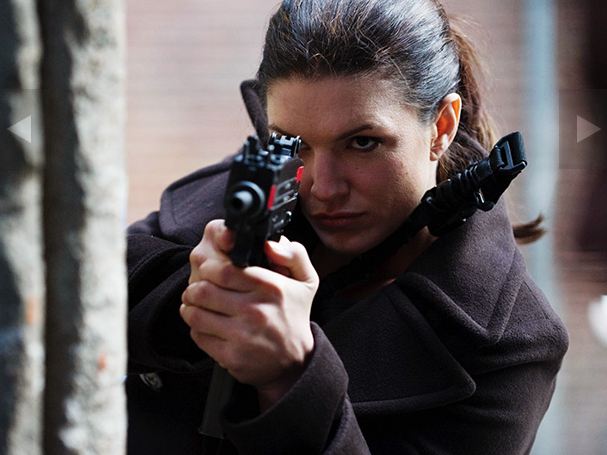
Despite its title, Steven Soderbergh's most recent film Haywire is anything but. Newcomer (and MMA fighter) Gina Carano plays Mallory, a private contractor (we don't really get the details of what she does) who gets sold out by one of her bosses. She sets out to find out who, and exact her revenge. The candidates are Ewan McGregor, Antonio Banderas, and Michael Douglas. Channing Tatum and Michael Fassbender play other contractors who either help her or try to hurt her, depending on the situation.
I really wanted to like this movie. I was excited about it, having loved The Limey, the previous collaboration between Soderbergh and screenwriter Lem Dobbs. Soderbergh does make some interesting choices, not least of which is casting Carano to play opposite a bevy of talented actors rather than no-namers who might not throw her lack of acting ability into sharp relief. Carano admirably holds her own, however. Dobbs does a good job of giving her dialog that she can manage, and Soderbergh helps by giving her hero shot after hero shot, making verbal banter unnecessary. In addition, he makes the right choice of having no score over the fight scenes, drawing our attention to each blow and the havoc it wreaks.
There is something lacking here, though, and I think that this is...well, there's nothing going haywire! Even as Carano's life falls apart around her, reducing the number of people she can trust to zero, that feeling is never really transferred to the audience. In an early scene, Carano chases a bad guy through the streets of Barcelona, but despite the fact that they're both moving quickly, the scene lacks energy. It won't be a popular opinion, but I think Haywire could have used an edit by the Tony Scott school of quick cuts, blurry motion, and frenetic pace. This goes against everything that Soderbergh believes in (and everything that he's done so well in past, e.g Traffic, Erin Brockovich, The Informant!, and yes, The Limey) but feels necessary here.
It's not a film about Carano working through clues...when her chief antagonist escapes to Mexico near the end of the film, she finds him in the next sequence, with no explanation for the viewer. It's not a thriller: Carano's victory is never in doubt, and her adversaries are obvious from the beginning. In a sense, it's no different than any film vehicle for an MMA fighter or professional wrestler (think The Condemned or 12 Rounds). Put adversaries in his or her path; let the butt-kicking commence. Soderbergh, Dobbs, and the rest of the cast lend an air of respectability, and Carano is beautiful and a physical powerhouse. It's a pretty picture, but like Soderbergh's other notable style-over-substance effort The Good German, there doesn't seem to be much point to the exercise.
Haywire: 3 stars out of 5
I really wanted to like this movie. I was excited about it, having loved The Limey, the previous collaboration between Soderbergh and screenwriter Lem Dobbs. Soderbergh does make some interesting choices, not least of which is casting Carano to play opposite a bevy of talented actors rather than no-namers who might not throw her lack of acting ability into sharp relief. Carano admirably holds her own, however. Dobbs does a good job of giving her dialog that she can manage, and Soderbergh helps by giving her hero shot after hero shot, making verbal banter unnecessary. In addition, he makes the right choice of having no score over the fight scenes, drawing our attention to each blow and the havoc it wreaks.
There is something lacking here, though, and I think that this is...well, there's nothing going haywire! Even as Carano's life falls apart around her, reducing the number of people she can trust to zero, that feeling is never really transferred to the audience. In an early scene, Carano chases a bad guy through the streets of Barcelona, but despite the fact that they're both moving quickly, the scene lacks energy. It won't be a popular opinion, but I think Haywire could have used an edit by the Tony Scott school of quick cuts, blurry motion, and frenetic pace. This goes against everything that Soderbergh believes in (and everything that he's done so well in past, e.g Traffic, Erin Brockovich, The Informant!, and yes, The Limey) but feels necessary here.
It's not a film about Carano working through clues...when her chief antagonist escapes to Mexico near the end of the film, she finds him in the next sequence, with no explanation for the viewer. It's not a thriller: Carano's victory is never in doubt, and her adversaries are obvious from the beginning. In a sense, it's no different than any film vehicle for an MMA fighter or professional wrestler (think The Condemned or 12 Rounds). Put adversaries in his or her path; let the butt-kicking commence. Soderbergh, Dobbs, and the rest of the cast lend an air of respectability, and Carano is beautiful and a physical powerhouse. It's a pretty picture, but like Soderbergh's other notable style-over-substance effort The Good German, there doesn't seem to be much point to the exercise.
Haywire: 3 stars out of 5
Monday, January 9, 2012
Movie Review: Mission Impossible - Ghost Protocol
The fourth installment in the Mission: Impossible franchise brought together two of my favorite things: Mission: Impossible and Brad Bird. Mission: Impossible, you're probably familiar with...Brad Bird, perhaps not so much. I first became aware of Brad Bird as an avid Simpsons watcher. Bird served as "executive consultant" for 182 Simpsons episodes from 1989 to 1998, the period everyone agrees is are the show's glory years. Listening to the commentaries on those episodes (The Simpsons DVDs provide audio commentary on every single episode) is like listening to the coronation of a king. Bird is renowned in the animation world as something of a story-telling and animation savant, always coming up with the perfect idea or narrative beat for the situation, and a way to work out the imagery. His first feature, the (hand-drawn) animated The Iron Giant, is a critically-heralded and beautiful piece of work. His next two features were for the powerhouse Pixar Animation Studios (Toy Story, Finding Nemo), The Incredibles and Ratatouille.
And then, seemingly out of the blue, Tom Cruise and J.J. Abrams hired him to direct the next Mission: Impossible project, his first non-animated assignment. Everyone was curious to see how this animation maven could do with live actors.He did great. In Mission: Impossible - Ghost Protocol, Cruise returns as Ethan Hunt, head of a team of secret agents (including Paula Patton, Jeremy Renner, and a returning Simon Pegg) who are falsely accused of blowing up the Kremlin. It turns out that a madman (Cruise keeps running into those, doesn't he?) wants to start a nuclear war in order to wipe the human slate clean and start over. The cast performs admirably, although Jonathan Rhys Myers and Maggie Q are missed from M:I 3. Ving Rhames, a staple of the first three films, does show up, but only for a cameo in the coda. The real drop-off,a and maybe the only reason Ghost Protocol comes up a tiny bit short of its predecessor, is on the "villainous madman" front. Philip Seymour Hoffman chewed scenery wonderfully in M:I 3, and the stoic cipher played by Michael Nyqvist can't compete here. He's not bad, he's just not memorable.
The star of the show, fortunately, is Bird's camera. Whether he's circling Cruise clinging to the side of the world's tallest building in the face of an oncoming sandstorm or quietly following a cat-and-mouse parlor game exchange of launch codes and diamonds, Bird is in control. A final sequence in a high-tech automatic car-park is almost without equal. The action is pulse-pounding, but always easy to follow. Michael Giacchino provides the score, and his action beats and theme (another derivation of Lalo Schifrin's original classic) are far superior to his occasionally tone-deaf where-in-the-world-are-we scene settings (a loud russian hymn, reminiscent of The Hunt for Red October, annoyingly announces that we're in the Kremlin).
As Cruise and his team inevitably triumph, saving the world, we might start asking ourselves why we were so worried that Bird wouldn't do the same.
Mission: Impossible - Ghost Protocol: 4 stars out of 5
Tuesday, January 3, 2012
Movie Review: The Descendants
It's been a while since Alexander Payne made a movie. He's one of my favorite directors, and I've loved all his films. Sideways (2004) was probably his most successful work, and in the 7 years since it came out, I've been anxiously awaiting his next offering.
I loved The Descendants. It's not an overwhelming film, in the sense that you don't walk out of the theater thinking, "WOW! What a movie!" In fact, as I left the theater, I wouldn't have put it among Payne's best work. Let the story percolate for a few days, though, and it only gets sweeter.
George Clooney plays a descendant (get it?) of King Kamehameha and, as such, a trustee of vast expanses of Hawaiian paradise. Life is not all cocktails and beach blankets, though, as he deals with a dying wife, daughters he can't control, and disturbing revelations about the past. The performances are measured and believable. Shailene Woodley, especially, is excellent as Clooney's eldest. The best thing about The Descendants, though, is the writing. And I don't mean the dialogue; Payne, Nat Faxon, and Jim Rash (Dean Pelton on Community, of all things) adapt a Kaui Hart Hemmings novel, and between the four of them, they just nail it.
The film has twin themes, and both resonate deeply: first, that things are often NOT going to be okay, despite our protestations, and second, that it is precisely in these situations that we find ourselves drawn closest to those we love. Clooney's Matt King suffers in the same way that the less fortunate do. Despite his friends' and family's continued assertions that "everything will be okay," and that his wife is "strong" and that "she'll beat this," Clooney knows better. Payne continually cuts to the wife, in bed, immobile and dying, not shying away from close-ups, driving home the point that this thing is not okay.
Clooney admits pointedly throughout the film that he "doesn't know what to do" with his daughters, but finds the travails of normal life bringing his family together, in ways that he never expected. What you can expect? Another heartfelt and beautiful Alexander Payne film, right in line with his best work.
The Descendants: 4 stars out of 5
I loved The Descendants. It's not an overwhelming film, in the sense that you don't walk out of the theater thinking, "WOW! What a movie!" In fact, as I left the theater, I wouldn't have put it among Payne's best work. Let the story percolate for a few days, though, and it only gets sweeter.
George Clooney plays a descendant (get it?) of King Kamehameha and, as such, a trustee of vast expanses of Hawaiian paradise. Life is not all cocktails and beach blankets, though, as he deals with a dying wife, daughters he can't control, and disturbing revelations about the past. The performances are measured and believable. Shailene Woodley, especially, is excellent as Clooney's eldest. The best thing about The Descendants, though, is the writing. And I don't mean the dialogue; Payne, Nat Faxon, and Jim Rash (Dean Pelton on Community, of all things) adapt a Kaui Hart Hemmings novel, and between the four of them, they just nail it.
The film has twin themes, and both resonate deeply: first, that things are often NOT going to be okay, despite our protestations, and second, that it is precisely in these situations that we find ourselves drawn closest to those we love. Clooney's Matt King suffers in the same way that the less fortunate do. Despite his friends' and family's continued assertions that "everything will be okay," and that his wife is "strong" and that "she'll beat this," Clooney knows better. Payne continually cuts to the wife, in bed, immobile and dying, not shying away from close-ups, driving home the point that this thing is not okay.
Clooney admits pointedly throughout the film that he "doesn't know what to do" with his daughters, but finds the travails of normal life bringing his family together, in ways that he never expected. What you can expect? Another heartfelt and beautiful Alexander Payne film, right in line with his best work.
The Descendants: 4 stars out of 5
Wednesday, November 30, 2011
Predator vs. Predators
Director: Nimrod Antal
Stars: Adrien Brody, Alice Braga, Topher Grace
In his 2010 film Predators, Nimrod Antal makes a couple of good choices right off the bat. First he decides to completely eschew the mythology that sprang up following the release of the 1987 classic Predator. A second film, Predator 2 (1990), a couple of Alien vs. Predator movies (2004 and 2007), and several series of comics greatly expanded the franchise, but left some fans of the original wishing for a return to simpler times. Predators is advertised as a "direct" sequel to Predator.
Antal's second smart move is to hire good (or at least known) actors. Brody, Braga, and Grace and joined by Laurence Fishburne, Danny Trejo, Walton Goggins, and Oleg Taktarov, who will all be recognized from many other films. These are not your standard cardboard-cut-outs-picked-off-one-at-a-time people. We can expect more from them.
Third, the movie has a pretty killer hook: the first shot of the film is Brody waking up in free fall, plummeting to what he can only assume is earth. We find out, though, that he is one of eight ruthless killers (including black-ops military, yakuza, a death row inmate, an RUF fighter from Sierra Leone, etc) brought to a planet-sized game preserve to be hunted by Predators for sport. Get it? The Predators have gathered Earth's predators. Potentially cool, right?
But then...that's it. These actors who are capable of giving characters some depth and shading don't. They become the thing that should have been avoiding most of all: cardboard cut-outs, picked off one by one. Predators becomes a generic monster movie. The "good" actors in Predators fail to do what the lesser actors in Predator did so well: be fun. Predator's cast includes Arnold Schwarzenegger, Carl Weathers, Jesse Ventura, Bill Duke, Sonny Landham, and Shane Black. No standout thespians in that list, but a lot of scenery-chewing fun. Note the different expressions on Brody's and Ventura's faces.
Predators makes the cardinal mistake of a campy action movie: it forgets that watching a campy action movie is supposed to be FUN! I want to laugh at Jesse Ventura saying that he "ain't got time to bleed." I want to laugh at Arnold Schwarzenegger pinning a bad guy to a pole with a thrown machete and cracking wise: "Stick around." Predators is ridiculously...serious. An oxymoron, perhaps, but nonetheless a death-knell for an action movie.
Final Analysis:
Predators: 1.5 self-serious stars out of 5
Predator: 4.5 self-aware stars out of 5
Stars: Adrien Brody, Alice Braga, Topher Grace
In his 2010 film Predators, Nimrod Antal makes a couple of good choices right off the bat. First he decides to completely eschew the mythology that sprang up following the release of the 1987 classic Predator. A second film, Predator 2 (1990), a couple of Alien vs. Predator movies (2004 and 2007), and several series of comics greatly expanded the franchise, but left some fans of the original wishing for a return to simpler times. Predators is advertised as a "direct" sequel to Predator.
Antal's second smart move is to hire good (or at least known) actors. Brody, Braga, and Grace and joined by Laurence Fishburne, Danny Trejo, Walton Goggins, and Oleg Taktarov, who will all be recognized from many other films. These are not your standard cardboard-cut-outs-picked-off-one-at-a-time people. We can expect more from them.
Third, the movie has a pretty killer hook: the first shot of the film is Brody waking up in free fall, plummeting to what he can only assume is earth. We find out, though, that he is one of eight ruthless killers (including black-ops military, yakuza, a death row inmate, an RUF fighter from Sierra Leone, etc) brought to a planet-sized game preserve to be hunted by Predators for sport. Get it? The Predators have gathered Earth's predators. Potentially cool, right?
But then...that's it. These actors who are capable of giving characters some depth and shading don't. They become the thing that should have been avoiding most of all: cardboard cut-outs, picked off one by one. Predators becomes a generic monster movie. The "good" actors in Predators fail to do what the lesser actors in Predator did so well: be fun. Predator's cast includes Arnold Schwarzenegger, Carl Weathers, Jesse Ventura, Bill Duke, Sonny Landham, and Shane Black. No standout thespians in that list, but a lot of scenery-chewing fun. Note the different expressions on Brody's and Ventura's faces.Predators makes the cardinal mistake of a campy action movie: it forgets that watching a campy action movie is supposed to be FUN! I want to laugh at Jesse Ventura saying that he "ain't got time to bleed." I want to laugh at Arnold Schwarzenegger pinning a bad guy to a pole with a thrown machete and cracking wise: "Stick around." Predators is ridiculously...serious. An oxymoron, perhaps, but nonetheless a death-knell for an action movie.
Final Analysis:
Predators: 1.5 self-serious stars out of 5
Predator: 4.5 self-aware stars out of 5
Subscribe to:
Posts (Atom)